“Pick up and drop” can mean a robot loading a machine, a pallet moving between storage and production, or a tray indexing into an inspection station. Define the load unit, route, rate, accuracy, and failure response first; then you can compare equipment types and request a quotation that matches your plant rather than a vague machine category.
Key takeaways
- Define the load unit, destination, cycle time, and placement accuracy before comparing systems.
- Choose gantry, robot, conveyor, or lift architecture from the plant movement.
- Specify gripper, part presentation, safeguards, utilities, and recovery sequences in the RFQ.
- Use representative parts to prove throughput and reliability during FAT and SAT.
Define the Pick-Up and Drop Job Before Comparing Equipment
A pick-up and drop job is defined by the load unit and its destination, not by the word “automation.” Decide whether the system moves a pallet, tote, bin, carton, tray, or individual component; then state whether it loads a machine, transfers a bin between stations, indexes a tray, or places a finished part at end of line.
- Name the load: material, part number, quantity, weight, dimensions, centre of gravity, surface finish, burrs, oil, dust, temperature, and permitted contact points.
- Fix the pickup and drop coordinates: source location, destination location, presentation height, approach direction, placement tolerance, storage depth, and the clearance around each position.
- State the demand: required cycle time, peak completed moves per hour, shift pattern, and simultaneous demand from production, replenishment, dispatch, empty-container return, and stoppage recovery.
- Describe the presentation: loose, nested, stacked, oriented, singulated, or randomly placed. Include the acceptable variation in position and orientation.
- Record the route: fixed point-to-point movement or variable destinations, plus barcode or RFID identity, PLC handshake, and the action after a missed pick, failed scan, blocked destination, or lost vacuum.
This turns “automated pick up drop for system in Pune” into a measurable requirement. It also prevents a supplier from sizing an automated pickup drop machine against average volume when shift changes or dispatch peaks demand more capacity. Compare usable moves per hour, intervention time, and recovery behaviour—not robot payload or purchase price alone.
Match the Plant Movement to the Right Automation Architecture
Choose the architecture by route variability, load unit, reach, and peak cycle demand—not by robot payload alone. A material pickup drop system in Pune may combine several architectures rather than use one machine for every movement.
| Option | Best fit | Choose it when |
|---|---|---|
| Fixed pick-and-place cell | Machine loading, unloading, or part orientation | The station, pickup point, and drop point stay fixed and cycle time is short |
| Cartesian or gantry system | X-Y-Z movement over a defined work area | You need straight-line accuracy, predictable access, and a large rectangular envelope |
| Robot cell | Variable orientations, multiple machines, or complex approach angles | Parts need reorientation, several gripping points, or frequent product changeovers |
| Conveyor transfer | Pallets, totes, cartons, or trays moving between fixed stations | The route is permanent and continuous flow matters more than flexible routing |
| Loader or feeder | Presenting components to a machine | Parts require singulation, orientation, bowl feeding, or controlled insertion |
| AGV or AMR | Pallet and tote movement across changing routes | Destinations or plant layouts change; provide charging, traffic control, and pedestrian segregation |
| Rail-guided trolley | Repeated movement along one dedicated path | Loads are heavy, the route is fixed, and floor traffic must stay clear |
| ASRS | High-density pallet, tote, or bin storage | You need controlled inventory locations, vertical storage, and automated retrieval |
Use conveyors, pallet shuttles, or ASRS for repeatable fixed pallet movements. Select a robot or custom cell when part geometry and presentation dominate. An automated pickup drop machine in Pune still needs PLC, scanners, safety devices, and WMS or MES handshakes defined in the RFQ.
Size the Gripper, Presentation, and Cycle for Real Production
Reliable pickup and placement depend on the part, presentation, gripper, and complete cycle—not the robot’s advertised payload. Specify dimensions, weight, material, centre of gravity, surface finish, gripping points, burrs, oil, dust, temperature, placement tolerance, and the worst-case orientation.
Include gripper, cables, tooling, product, and eccentric loads in the payload calculation; acceleration and braking can make a rated payload unusable.
End-effector choice follows those conditions:
| Option | Best fit | Main failure risk |
|---|---|---|
| Parallel gripper | Rigid parts with accessible sides and repeatable geometry | Burrs or dimensional variation prevent full jaw contact |
| Vacuum cup | Smooth cartons, trays, glass, or sealed components | Oil, dust, porous surfaces, or a leaking seal causes vacuum loss |
| Fork, clamp, or custom fixture | Pallets, bins, heavy loads, or irregular parts | Poor load support or a shifting centre of gravity damages the load |
Presentation deserves equal attention. Use a nest, singulator, orientation guide, or conveyor stop when parts arrive overlapped, rotated, or at inconsistent heights. Add vacuum-loss or grip confirmation, gripper-change time, and a defined missed-pick recovery path.
Calculate hourly capacity from the full sequence:
- Include approach, sensing or vision processing, grip actuation, lift, travel, placement, withdrawal, PLC handshakes, conveyor indexing, inspection, reject handling, and retries.
- Test peak simultaneous demand from production, replenishment, dispatch, empty-container return, and stoppage recovery—not average daily volume.
- Validate a custom pick and place system in Pune with oily, dusty, mixed-condition production loads, worst-case orientations, and measured placement accuracy and recovery time.
Specify the Complete Flow, Not Just the Pickup-and-Drop Motion
Specify the complete material path, not merely the robot’s travel between two coordinates. An automated pickup drop machine in Pune must handle peak simultaneous demand from production, replenishment, dispatch, empty-container returns, and stoppage recovery. Otherwise, it may meet the daily average while starving a line during shift change.
- Feeding: define how pallets, totes, bins, trays, cartons, or components arrive, including singulation, orientation, and presentation height.
- Detection: use presence, position, weight, barcode, RFID, or vision checks to validate the load before pickup.
- Buffering: provide accumulation capacity for blocked conveyors, machine downtime, shift changes, and downstream delays.
- Transfer: specify conveyors, lifts, indexing units, robot handshakes, and destination coordinates.
- Confirmation: require pickup, placement, identity, and destination confirmation before releasing the next load.
- Reject: route damaged, misoriented, unscanned, duplicate, or failed parts to a controlled reject station.
- Safety: include guarding, interlocked gates, emergency stops, safe speed zones, light curtains, access resets, earthing, short-circuit assumptions, and panel documentation; confirm Indian statutory duties and use IEC 60204-1 as a machinery-electrical reference.
- Recovery: define retry limits, vacuum-loss or gripper-fault response, manual removal, homing, and restart after power loss.
- Software: assign ownership for PLC, HMI, WCS, WMS, and MES interfaces, message formats, product identity rules, timestamps, and failed scan or handshake behaviour.
Put these sequences into the RFQ. A quoted robot cycle that excludes sensing, indexing, handshakes, rejects, and retries is not a production capacity.
Prepare a Comparable RFQ and Prove It at FAT and SAT
Do not issue an RFQ for an “automated pick up drop for system in Pune” without a testable load profile.
Give each supplier the part or container drawings, payload and centre-of-gravity limits, pickup and drop coordinates, presentation height, storage depth, placement tolerance, peak moves per hour, shift pattern, and conditions such as oil, dust, burrs and temperature.
Include these RFQ requirements:
- Define simultaneous demand from production, replenishment, dispatch, empty-container return and stoppage recovery, not the daily average.
- State barcode or RFID rules, PLC handshakes, WMS, MES and safety-interface ownership, message formats, and actions after a failed scan or destination.
- Require the supplier to identify the gripper, part nest, singulation method, missed-pick detection, reject route and manual recovery procedure.
- Request installed performance, usable locations or line interfaces, operator interventions per shift, maintenance access, spare-parts lead time and exclusions.
Whether you compare Dofort or another integrator, use one acceptance sheet for every proposal. A material pickup drop system in Pune passes only with production-representative loads, including oily, dusty, mixed-condition and fault cases.
| Test | FAT evidence | SAT acceptance |
|---|---|---|
| Throughput | Peak completed moves/hour for 8 hours | Same rate during a full production shift |
| Placement | 100 consecutive placements within specified tolerance | No tolerance breach in production sampling |
| Scan accuracy | 100% identity and destination matches | Same result across all live interfaces |
| Recovery | Logged time after missed pick, jam and failed handshake | Operator restores flow within specified minutes |
| Availability | Demonstrated run time excluding planned stops | Measured against the contracted percentage |
| Safety | Guard, interlock and emergency-stop response time | Verified at every access point before handover |
Related product
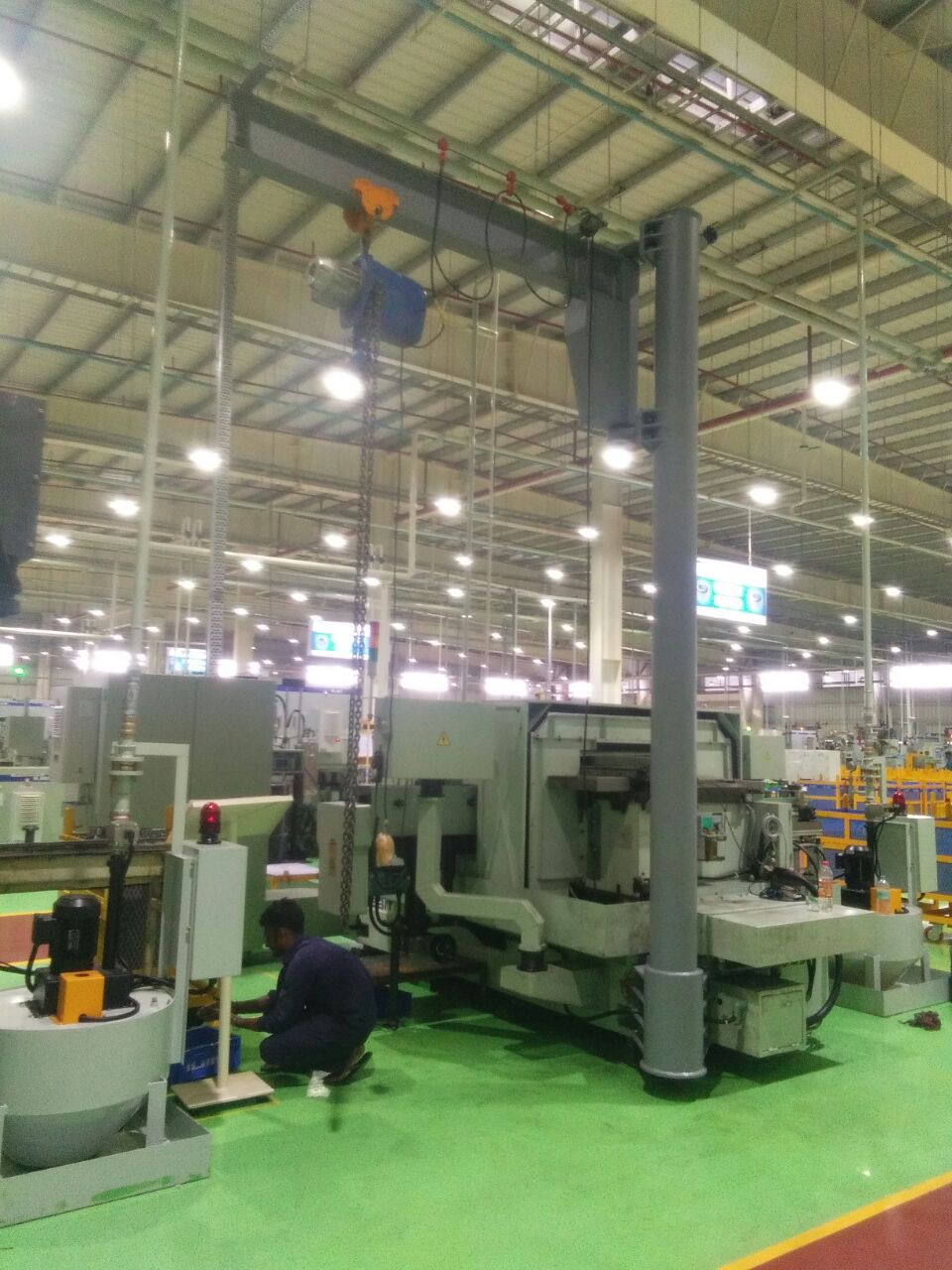 | Automation SPM Automated Pick Up & Drop System Pickup & Drop System – Industrial Automation Solution System Description: A custom-built automated system designed to pick components from a defined... View product → |
Frequently asked questions
What should you define before selecting an automated pickup-and-drop system?
State the load unit, destination, part orientation, payload, cycle time, placement accuracy, and production schedule.
How do you match plant movement to an automation architecture?
Use the movement pattern to compare robots, gantries, conveyors, lifts, and custom pick-and-place systems.
What gripper and presentation details belong in the specification?
Specify part geometry, weight, surface, gripping points, orientation, presentation method, changeover, and reject handling.
What should a complete pickup-and-drop RFQ include?
Include infeed, pickup, transfer, placement, outfeed, controls, guarding, safety devices, utilities, fault recovery, and maintenance access.
How should you validate a custom system before installation?
Use representative parts and production conditions at FAT, then confirm installation, integration, safety, and performance at SAT.