The right hand pallet truck depends on more than its advertised load rating: pallet entry, load-centre distance, aisle clearance, floor condition, travel frequency, and monsoon exposure all change the decision. By the end, you will be able to compare manual and powered options, calculate a usable capacity, and specify the dimensions and features your Pune warehouse actually needs.
Key takeaways
- Choose a standard manual truck for short, level moves on finished concrete.
- Calculate capacity using load weight, pallet condition, centre of gravity, and route.
- Choose battery operation when distance, gradients, or repeated travel increase operator strain.
- Verify fork dimensions, steering clearance, brakes, wheels, warranty, and service support before buying.
Which hand pallet truck type fits your warehouse duty?
Choose a standard manual truck for short, level moves on finished concrete; choose another hand pallet truck for warehouse duty only when the route or load demands it. Compare hand pallet truck types in Pune by task, not headline capacity.
| Type | Best fit | Main limitation |
|---|---|---|
| Standard manual | Short indoor moves on smooth, level concrete | Operator effort rises with distance, ramps, and heavy loads |
| Low-profile | Pallets or skids with 51–65 mm bottom clearance | Reduced ground clearance exposes it to damaged floors, dock plates, and debris |
| High-lift or scissor | Order picking and work positioning, lifting to about 800 mm | Raised-height capacity often near 1,000 kg; do not use as a personnel lift |
| Weighing | Weighing pallets during movement | Level loading and calibration control accuracy; confirm Indian legal-metrology approval for trade |
| Stainless-steel or galvanized | Wash-down, food, pharmaceutical, chemical, and wet areas | Specify corrosion-resistant seals, bearings, fasteners, hydraulics, and wheels—not only the frame |
| Rough-floor | Outdoor paving and uneven approaches | Pneumatic or larger rubber wheels increase turning effort and aisle demand |
Check the high-lift rating at 800 mm, not just the floor-level rating, and never travel with raised forks beyond the manufacturer’s transport limit. A weighing truck saves a separate weighing step, but an uneven load can produce a misleading reading.
For smooth aisles, polyurethane rollers usually suit the baseline; rough routes need larger rubber or pneumatic wheels, provided the turning envelope still fits.
How does a manual pallet truck work, and how do you check fit?
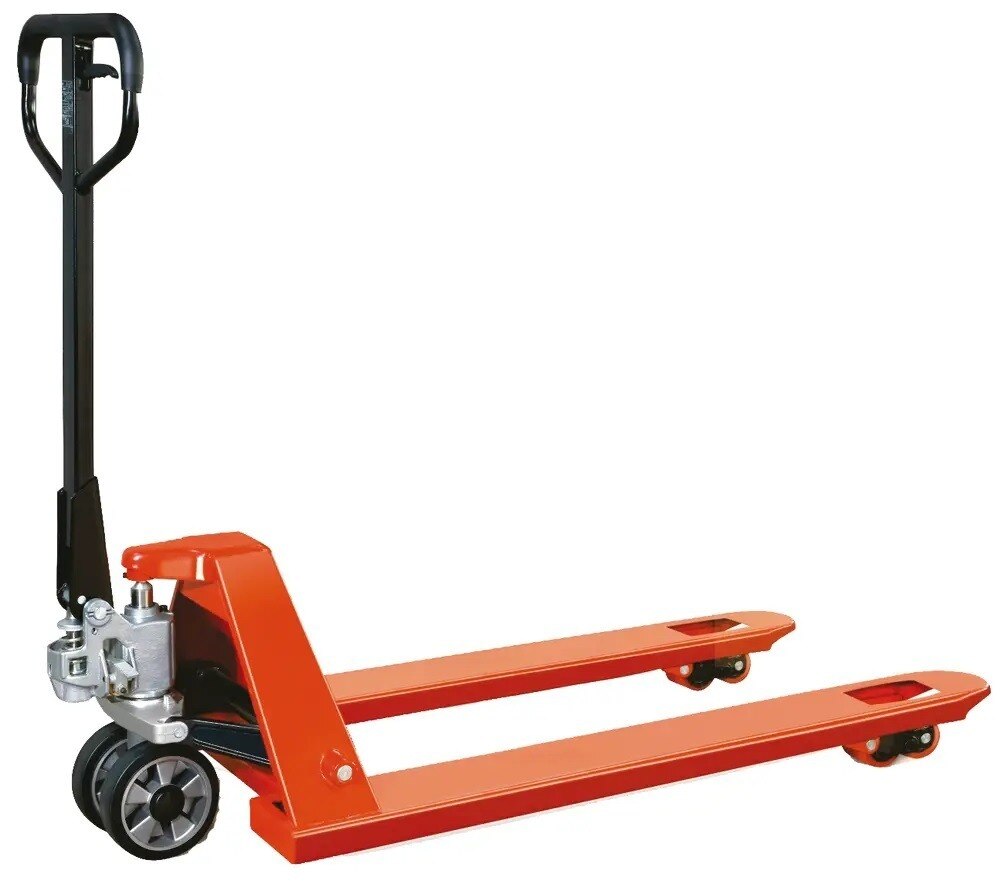
Pulling the pump handle operates a hydraulic cylinder and raises the forks; the lowering control releases hydraulic pressure and lowers them. Steer wheels pivot beneath the handle, while load rollers under the fork tips carry the pallet. Keep forks fully inserted before moving.
Measure these dimensions before choosing a hand pallet truck for warehouse use:
- Pallet length and width, fork-entry opening, and fork-pocket height
- Fork length, thickness, outside width, and the complete turning radius with the handle swept
- Pallet overhang, operator position, aisle width, rack-upright clearance, dock, trailer, and conveyor clearances
Confirm the entry direction against the pallet’s bottom-board layout. A 550 mm fork width and a 685 mm fork width suit different footprints, but neither is automatically safer: incorrect spacing can strike pallet blocks, miss the entry channel, or leave the load unevenly supported.
Do not assume adjustable spacing or a particular fork length unless the supplier states it.
Wheel and roller choices also affect fit and handling in a manual pallet truck comparison.
| Wheel or roller | Practical effect | Check it against |
|---|---|---|
| Polyurethane wheels | Quiet, low-resistance travel | Finished concrete |
| Nylon wheels | Higher load tolerance, more shock and noise | Heavy loads and rougher floors |
| Single or tandem rollers; larger diameter | Changes joint crossing, shock, and turning effort | Expansion joints, dock plates, and aisle space |
Check the full steering and turning envelope, including pallet overhang; fork width alone does not prove aisle compatibility.
How do you calculate the pallet truck load capacity you actually need?
Base the pallet truck load capacity on the heaviest gross load moved during peak production, dispatch, or receiving—not on the average pallet. Include the pallet, packaging, wrapping, and any concentrated item such as a motor or metal coil.
A 2,500 kg rating commonly applies at a 600 mm load centre. The load’s centre of gravity must remain within 600 mm of the fork face; a longer pallet or a heavy item at the far end increases the overturning moment and reduces usable capacity.
| Check | Why it changes usable capacity |
|---|---|
| Peak gross load | Sets the minimum required rating |
| Load-centre distance | Longer distance increases overturning force |
| Load distribution | One heavy end overloads a fork and steering structure |
| Raised height | High-lift models need a separate capacity rating |
Ask for the derated capacity at your actual load-centre distance and, for a high-lift model, at the raised height. A floor-level rating does not prove safe handling near 800 mm.
Before lifting, inspect pallet boards, blocks, and deck openings. A damaged pallet can shift, bend, or collapse below the truck’s rating. Keep forks fully inserted and spaced for even support.
For a manual pallet truck comparison, record these purchase conditions:
- Peak gross load
- Load-centre distance
- Pallet condition
- Floor slope
Treat the nameplate rating as a condition-specific limit, not a guarantee.
When should you choose a manual or battery-operated pallet truck?
Choose a manual truck for short horizontal moves, few pallet movements per shift, level floors, and tight aisles; choose battery operation when distance, ramps, congestion, or load weight makes repeated pushing exhausting.
| Option | Duty cycle | Main trade-off |
|---|---|---|
| Manual | Short routes, limited movements, compact turning | Lowest complexity, but operator effort rises with distance and gradients |
| Battery-operated | Long repeated runs, ramps, heavy loads, or high movement frequency | Less pushing and pulling, but adds charging, controls, service, and safety procedures |
For a hand pallet truck comparison in Pune, calculate total pushing distance per shift, not pallet count alone. A hand pallet truck for warehouse use becomes a poor choice when operators cross a long facility repeatedly or queue around congested docks.
Ask for these battery-truck figures against your actual load:
- Rated travel speed and battery capacity
- Operating time under load and charge duration
- Spare-battery requirement and charger downtime
- Performance on ramps and in cold storage
For wet Pune loading bays or semi-outdoor staging, specify ingress protection, sealed bearings, protected hydraulics, drainable chassis areas, and a cleaning routine. Water can damage pump seals, pivot pins, bearings, springs, and scale electronics before forks visibly corrode.
If the truck interfaces with racks, conveyors, dock levellers, or automation, give Dofort the fork length and thickness, lowered and raised heights, load-wheel diameter, turning radius, pallet layout, and floor-loading limit. These details prevent a weight-compatible truck from colliding with equipment or failing to enter the pallet.
Related products
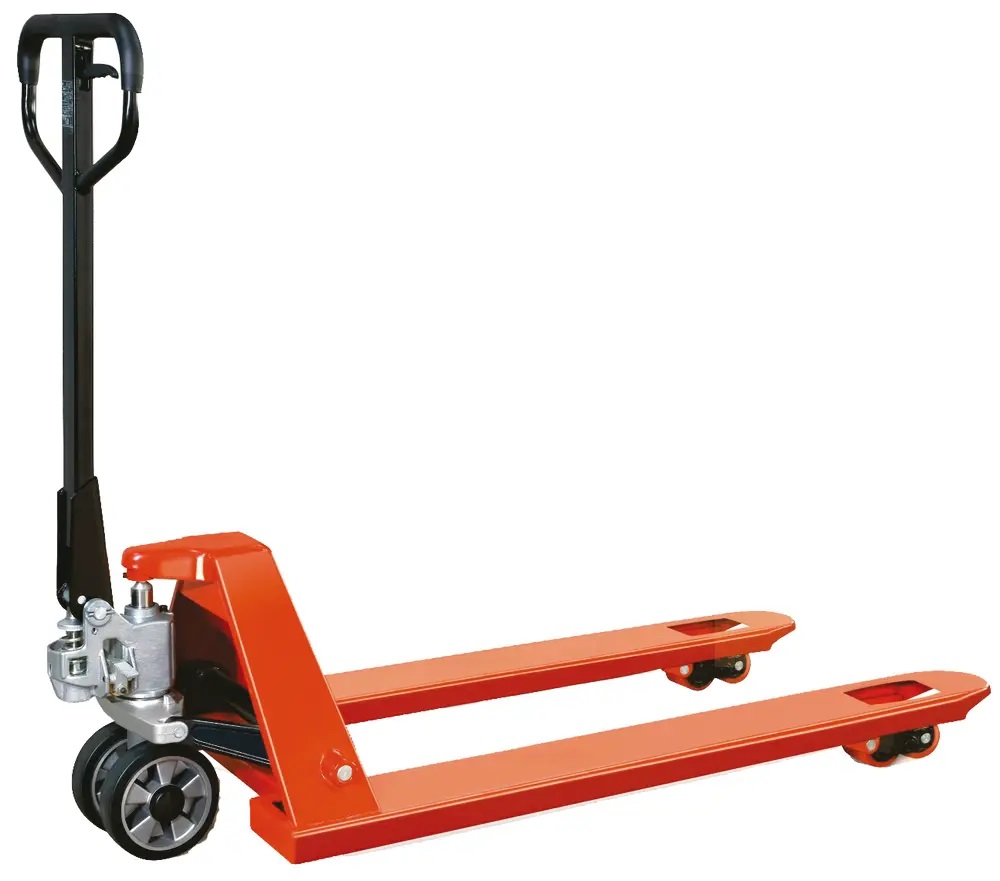 | Manual Equipment Capacity: 2500 / 3000 Kg Fork Width: 550 / 685 View product → |
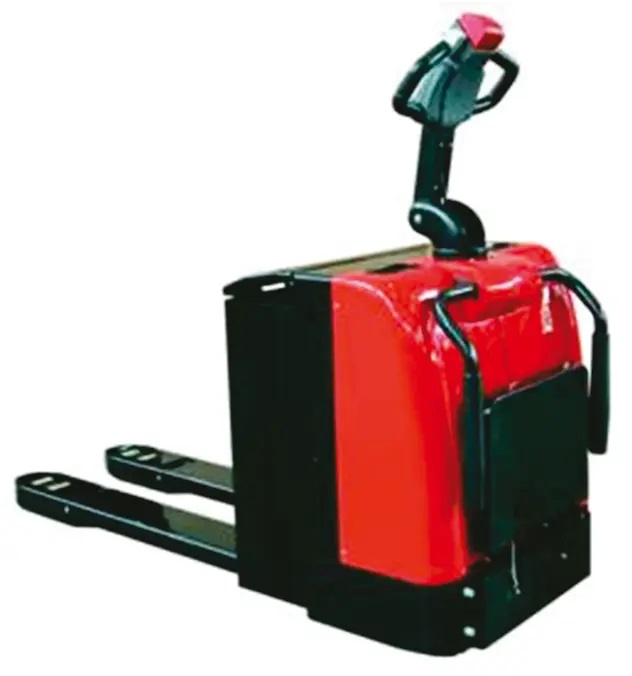 | Electrical Battery Operated Capacity: 2000-3000 Kg View product → |
What should you verify before buying for Pune conditions?
For hand pallet truck types in Pune, choose for the worst route, not the average one. Polyurethane wheels suit smooth indoor concrete with quiet, low-resistance rolling; nylon handles heavier loads and rougher floors but adds shock and noise.
Rubber or pneumatic wheels suit interlocking blocks and outdoor paving, yet increase turning effort, minimum radius, and sometimes fork-entry height.
A practical hand pallet truck comparison in Pune should include these conditions:
| Option | Best fit | Main trade-off |
|---|---|---|
| Indoor polyurethane | Finished concrete and narrow aisles | Poorer performance over joints and damaged paving |
| Nylon | Heavy loads and rougher indoor floors | More noise and transmitted shock |
| Rubber or pneumatic | Outdoor paving, ramps, uneven approaches | Larger turning envelope and greater steering effort |
Measure the narrowest aisle, smallest dock approach, steepest ramp, and worst floor joint. Request ISO 3691-5 conformity evidence for pedestrian equipment, then inspect:
- Handle geometry, guarding, emergency controls where fitted, parking or braking provisions, and stability.
- Calibration records for weighing models; confirm approval for invoicing, transport billing, or statutory transactions.
- Total duty-cycle cost: purchase, wheels, seals, hydraulics, batteries, chargers, charging downtime, and spare parts.
- A written acceptance test covering pallet entry, full-load travel, narrow-aisle turning, ramp movement, controlled lowering, parking, weighing accuracy, and operation after wet-bay cleaning.
For wet facilities, check corrosion-resistant seals, bearings, fasteners, hydraulics, and wheels—not only the frame.
Frequently asked questions
Which hand pallet truck type fits a Pune warehouse duty?
Use a standard manual pallet truck for short, level moves on finished concrete. Choose a specialised or battery-operated model when routes are longer, surfaces are uneven, gradients exist, or repeated travel creates operator strain.
How does a manual pallet truck work, and how do you check fit?
Hydraulic pumping raises the forks, while the steering handle guides the load. Check the pallet entry direction, fork length and width, aisle clearance, floor condition, turning space, and route distance before purchase.
How do you calculate the pallet truck load capacity you need?
Use the heaviest complete load, not the average load. Confirm the rated capacity, load-centre distance, pallet condition, centre of gravity, and any uneven or concentrated loading that could affect stability.
When should you choose a manual or battery-operated pallet truck?
Choose manual equipment for short, occasional transfers on level floors. Choose battery operation when operators cover long routes, move loads repeatedly, handle gradients, or need powered travel to reduce physical effort.
What should you verify before buying a hand pallet truck for Pune conditions?
Verify fork dimensions, minimum turning radius, wheel material, ground clearance, hydraulic performance, steering and braking controls, corrosion exposure, spare-parts availability, warranty terms, and local service response.