The right crane depends on the load path, coverage area, building structure, duty cycle and factory environment—not capacity alone. By the end, you can match a crane to production, maintenance, dispatch or storage work, calculate usable capacity, survey a Pune facility and compare supplier proposals on lifecycle fit.
Key takeaways
- Choose EOT cranes for fixed bays and unobstructed floor travel.
- Specify capacity from the heaviest lifted load plus lifting accessories.
- Check runway beams, headroom, power supply and columns before tendering.
- Compare safety systems, duty cycle, installation scope and local service support.
Match Each Crane Type to the Factory Task
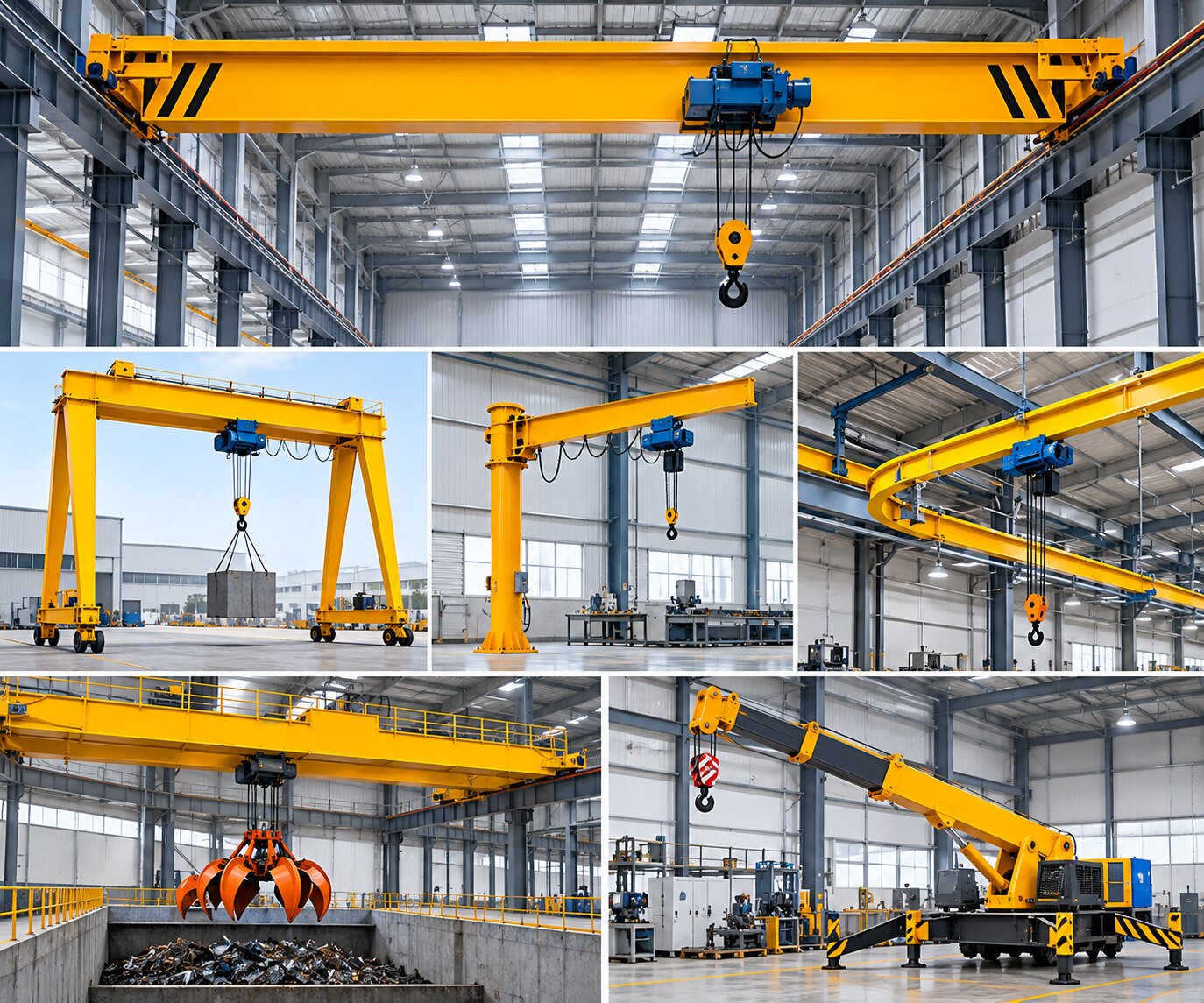
An EOT crane is the strongest default for a fixed production bay: it moves dies, moulds, motors and fabricated assemblies across the bay without blocking the floor. The right crane for manufacturing plant operations still depends on the task, travel path and building structure.
| Crane type | Best factory task | Why it fits and what to check |
|---|---|---|
| EOT or bridge crane | Die and mould handling, foundries, fabrication shops | Covers the full bay and keeps heavy loads above machines; verify runway beams, hook approaches, headroom and wheel loads. |
| Gantry crane | Outdoor yards, loading docks and bays without suitable columns | Runs on floor rails or wheels and avoids building-mounted runways; protect rails from vehicle traffic and confirm foundation capacity. |
| Jib crane | Machine loading, tool changes and local maintenance bays | Gives precise circular coverage around one workstation; its foundation or wall bracket carries concentrated reactions. |
| Monorail crane | Repetitive movement along an assembly or paint line | Follows a defined route efficiently; it cannot serve areas outside the fixed rail. |
| Workstation crane | Light assembly, ergonomic lifting and packing | Offers manual positioning with low floor obstruction; match the bridge span and rated capacity to each station. |
| Mobile crane | Temporary maintenance, outdoor erection and infrequent heavy lifts | Requires no permanent runway but consumes access space; plan ground bearing, outrigger clearance and shutdown controls. |
| AS/RS stacker crane | High-density warehouse storage and dispatch | Serves rack aisles accurately; specify pallet dimensions, aisle width, throughput and WMS integration rather than lifting capacity alone. |
For industrial crane types in Pune, record SWL with the hook block, magnet, grab or spreader weight included. A crane that reaches the payload but fails on attachment weight is underspecified.
Compare Coverage, Structure and Installation Requirements
An EOT crane covers the bay overhead, while a gantry covers an area between floor-supported legs. Jib, monorail and workstation cranes provide narrower coverage; a mobile crane trades fixed installation for clear travel routes and setup space.
| Crane type | Load path | Floor obstruction | Installation requirement |
|---|---|---|---|
| EOT or bridge | Hoist runs across a bridge on elevated runway rails | Minimal; loads pass above machines, racks and aisles | Runway beams, columns, end clearances, hook approaches and building capacity for wheel loads |
| Gantry | Bridge runs between legs on floor rails or wheels | Legs and rails occupy travel lanes; vehicles need separation | Rail alignment, foundations, storm restraint, wind design and floor tolerances |
| Jib | Hoist travels along a boom around one column or wall bracket | Column, foundation or wall zone remains occupied | Check outreach, overturning moment, support reactions and foundation anchorage |
| Monorail | Hoist follows one fixed overhead track | Minimal below the track, but movement is limited to its route | Suspended track supports, curves, switches, clearances and structural reactions |
| Workstation | Small bridge or hoist serves a defined work cell | Low; freestanding legs or ceiling supports can affect the cell | Modular floor anchoring or verified roof support, power and ergonomic clearances |
| Mobile | Boom carries the load from a vehicle or crawler to the ground | Highest during operation; route, outriggers and exclusion zones are required | Stable bearing surface, access route, setup area, overhead clearance and traffic control |
For an industrial crane comparison in Pune, request runway reactions, rail loads, foundation drawings and service access—not only SWL and price. A useful factory crane comparison also records span, lift, duty class, operating cycles, controls, power supply and inspection scope.
Calculate Usable Capacity and Specify the Duty Cycle
Start with the heaviest planned lift, not the average load. Specify industrial crane capacity as safe working load (SWL) or rated capacity, and define whether that figure includes the hook block and every below-the-hook attachment. The payload reaching production is lower when the crane rating includes a grab, magnet or spreader beam.
Use this calculation brief:
- Record the payload mass, centre of gravity and the number of lifting points. Include uneven load distribution between hooks, slings or support points.
- Add the mass of the hook block, slings, lifting beam, grab, magnet or other attachment included in the lifted load.
- Apply the engineered dynamic or impact factor for starting, stopping, hoisting and trolley travel. Do not invent a multiplier; obtain the factor from the crane designer and operating conditions.
- Check the resulting load against SWL, wheel loads, runway reactions, column stability and foundation capacity. Include transverse and longitudinal surge forces.
Duty cycle changes the machine even when SWL stays the same. State lifts per hour, average and peak loads, starts and stops, lift height, travel speeds, operating hours and required availability. A crane making occasional maintenance lifts needs different motors, brakes, controls and inspection intervals from one feeding continuous production.
Size for the production you will add, not only today’s heaviest component. Include planned increases in payload, lift frequency and operating hours in the duty classification requested from suppliers; otherwise a crane that passes commissioning can become the bottleneck.
Survey the Bay Before Selecting Span, Height and Controls
A 12-ton load does not automatically call for a 12-ton crane. The design brief must define the load, the bay and the work pattern before you compare an industrial crane capacity or choose a crane for manufacturing plant operations.
1. Measure the bay length, clear width, floor-to-roof height and obstructions such as lights, ducts, sprinklers, machines and storage racks. Record runway elevation, rail length, end approach, side approach and the minimum hook height needed above the highest load.
2. Identify the load precisely. State the heaviest payload, average load, lifting frequency and attachment weight, including the hook block, grab, magnet or spreader beam. Specify SWL or rated capacity with these below-the-hook items included or excluded; production payload falls when they are included.
3. Record operating conditions: lifts per hour, starts and stops, hoisting and travel speeds, lift height, required availability and expected future output. An intermittent maintenance crane and a production crane with identical SWL need different motors, brakes, controls and inspection plans.
4. Have a structural engineer verify runway beams, brackets, columns, rails, foundations and wheel loads. Include longitudinal and transverse surge, seismic loading and wind exposure where applicable; retrofitting supports after construction can delay commissioning.
5. Specify the control and service arrangement: pendant, radio or cabin control; variable-speed drives; upper and lower limits; overload protection; emergency stop; power supply; inspection access; ambient temperature; dust, moisture and corrosive chemicals. Put every value into a duty-and-layout matrix before requesting quotations.
Build a Pune Tender Comparison That Includes Safety and Service
Compare quotations on the same duty-and-layout matrix, not on purchase price or industrial crane capacity alone. Your industrial crane comparison in Pune should show SWL, attachment weight, span, lift, hook approaches, duty classification, operating cycles, speeds, environment, structural reactions, controls, power supply, service access, inspection scope and spare-parts support.
| Option | Tender checks | Cost or risk hidden by a low price |
|---|---|---|
| EOT or bridge crane | Runway reactions, rail alignment, surge forces, duty class, pendant or radio control, building review | Retrofitting beams, columns or access platforms |
| Gantry crane | Wheel loads, rail or floor tracks, foundation tolerances, storm restraint and vehicle clearance | Outdoor wind anchorage and rail maintenance |
| Jib, monorail or workstation crane | Outreach, support reactions, local coverage, anchor or foundation design and below-hook device | A rated load that falls at maximum outreach |
| AS/RS or stacker crane | Rack geometry, pallet size, aisle width, throughput, retrieval accuracy, WMS and fire protection | A capacity match that fails warehouse flow |
Put responsibility in writing: the supplier submits drawings, calculations, manuals, test records and load-test certificates; your team confirms the building, power, operating rules, trained operators and statutory inspection arrangements. Name the applicable Indian Standard, such as IS 3177 for electric overhead travelling cranes, in the purchase specification.
Require a spare-parts list, response time, preventive-maintenance schedule, inspection intervals and a breakdown escalation route. Ask Dofort to price these as separate line items so your factory crane comparison exposes lifecycle cost rather than hiding it in an attractive initial quote.
Related products
 | Loading / Lifting Equipment Industrial Cranes View product → |
 | Manual Equipment Capacity: 1000-2000 Kg Lift Height: 2000 mm View product → |
Frequently asked questions
Which crane type suits a fixed manufacturing bay?
An EOT crane suits a fixed production bay when loads must travel across the building without occupying floor space. Choose another type when the task requires outdoor coverage, a freestanding structure or a short lifting path.
How do you calculate industrial crane capacity?
Start with the heaviest load, then include hooks, slings, spreader beams, magnets or other lifting accessories. Specify the resulting safe working load and state the duty cycle based on lift frequency, travel distance and operating hours.
What should you survey before selecting a factory crane?
Measure bay span, runway length, hook travel, headroom, column positions, floor condition, power supply and access for installation. Check the building structure for runway and wheel loads before choosing the crane.
What should a Pune crane tender comparison include?
Compare rated capacity, span, lift and travel speeds, duty classification, controls, limit switches, overload protection, installation scope, testing documents, response times and preventive-maintenance support.