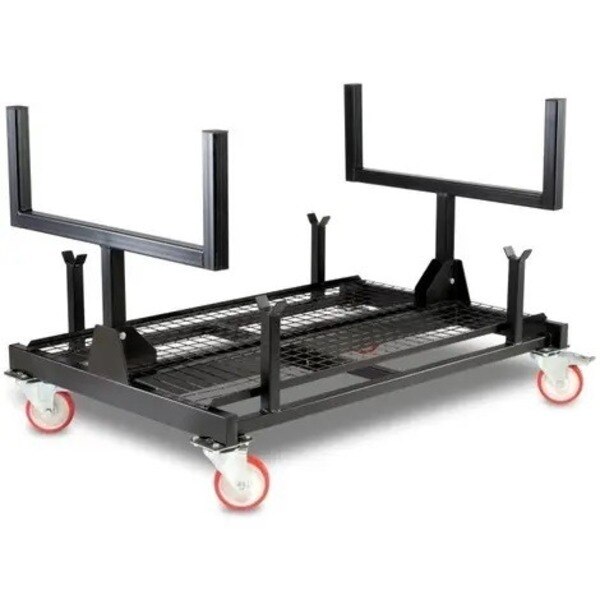
A quoted capacity and a rupee figure are not enough to compare skid trolleys: a 2,000 kg rating can mean a very different usable load depending on wheel loading, deck support, floor condition, and movement method. By the end, you will know how to define the load, estimate a realistic Pune budget, compare trolley types, and request a quotation that can be tested on your route.
Key takeaways
- Budget ₹20,000–₹60,000 for manual platform trolleys.
- Calculate capacity from load weight, centre of gravity, and floor conditions.
- Choose towable, powered, or rail-guided designs based on route and duty cycle.
- Compare quotations by deck, wheels, brakes, batteries, testing, and delivery scope.
What a Skid Trolley Costs in Pune—and What the Capacity Rating Means
A practical starting budget for a skid trolley in Pune is ₹20,000–₹60,000 for a manual platform, ₹60,000–₹2.5 lakh for a towable fabrication trolley, and ₹2–₹8 lakh for a powered battery trolley. Custom heavy-duty designs can exceed ₹10 lakh once reinforced decks, brakes, fixtures, batteries, chargers, and surface treatment are included.
These are planning bands, not supplier quotes; GST, freight, installation, and testing can sit outside them.
The phrase skid trolley capacity price in Pune is incomplete unless the quotation defines the load rating. Ask for all three figures:
- Rated payload: the total load the trolley is designed to carry.
- Uniformly distributed load (UDL): the payload spread across the stated deck area.
- Maximum point load: the greatest load applied at one foot, skid, wheel line, or specified contact area.
A trolley rated for 2,000 kg UDL may not carry a 2,000 kg machine resting on four small feet. The quotation and nameplate must also state deck dimensions, clear height, wheel material and diameter, wheel count, floor condition, travel speed, gradient, turning radius, towing or drive method, braking, and indoor or outdoor use.
These conditions define usable capacity.
Compare the complete configuration, not the headline tonnage. Wheel quantity and type, deck reinforcement, steering, towing hardware, brakes, powered drive, load fixtures, and paint or galvanising often change the price more than a small increase in payload.
How to Calculate Capacity for the Actual Load
A 2,000 kg machine does not automatically require a 2,000 kg trolley. Add the machine, pallet or skid, fixtures, and trolley dead weight to find the gross load; then check how that weight reaches the deck, wheels, and floor.
1. Weigh the complete moving load. Use the gross load, not the machine’s catalogue weight. Add a design allowance for acceleration, braking, ramps, thresholds, and floor joints rather than treating the trolley as a static platform.
2. Mark the load centre. A high or off-centre centre of gravity shifts force onto the nearest wheels and can lift the opposite side during turning. Specify deck dimensions and load-centre coordinates on the quotation.
3. Map every contact point. A 2,000 kg uniformly distributed load is different from a machine standing on four feet. State the maximum point load and each foot’s position; concentrated feet can bend the deck or overload one wheel.
4. Check wheel count and reactions. Do not divide gross load equally among all wheels. As a starting engineering check, size each wheel for gross load divided by the number of wheels minus one, then verify the frame, axles, and floor’s localised load.
5. Add movement forces. Tow speed, acceleration, braking, gradient, turning, dock plates, expansion joints, and uneven floors increase wheel and frame loads. A heavy duty skid trolley in Pune designed for a smooth slab may struggle on warehouse thresholds, so state these conditions before approving capacity.
Manual, Towable, Motorized, or Rail-Guided: Which Trolley Fits the Route?
For 300 kg, a manual trolley is usually adequate on a smooth, level floor. At 1,000 kg, choose towable equipment for repeated movement; at 2,000 kg, use a towable or motorized trolley unless travel is short and tightly controlled.
| Option | Best fit | Wrong choice when |
|---|---|---|
| Manual | 300 kg; short, level routes with occasional movement | The operator must overcome a ramp, threshold, high rolling resistance, or frequent starts |
| Towable | 1,000–2,000 kg; repeated movement behind a forklift, tug, or tractor | No suitable towing vehicle, safe turning space, or defined braking arrangement exists |
| Motorized | 1,000–2,000 kg; long routes, frequent trips, gradients, or precise positioning | Battery charging, controls, maintenance, and aisle clearance are unavailable |
| Rail-guided | 1,000–2,000 kg on a fixed, repetitive route | The route changes, floor tracks are impractical, or multiple destinations are required |
A manual trolley’s rated capacity does not mean one person can push it safely. Starting force rises with wheel resistance, floor joints, slope, load distribution, and acceleration. A 2,000 kg manual unit can be the wrong purchase even when its frame passes a static load test.
Rail guidance removes steering variation but permanently commits the route. Motorized units add control and braking, yet require a clear travel path and a speed limit suited to pedestrians.
If you search “buy skid trolley in pune,” specify the route, gradient, travel frequency, towing vehicle, floor condition, and stopping method. Otherwise, quotations labelled 300 kg, 1,000 kg, or 2,000 kg will not describe equivalent equipment.
Wheels, Frame, Steering, and Floor Conditions That Change Usable Capacity
Capacity on paper becomes usable capacity only when the trolley matches the route. A quoted 5-ton rating can fail in practice if small wheels concentrate load on a cracked slab, the frame deflects under an off-centre load, or towing forces act on a weak point.
Specify these details in the quotation:
- Wheel material: polyurethane for smooth indoor floors, nylon for lower rolling resistance, or steel for severe point loading. State the wheel diameter; larger wheels cross expansion joints, dock plates, and thresholds more easily.
- Wheel count and arrangement: identify load-bearing wheels, swivel casters, fixed wheels, and the rated load per wheel. More wheels do not increase capacity if the floor is uneven and one wheel lifts.
- Frame dimensions: give deck length, width, cross-member spacing, edge reinforcement, and the load centre. A long deck needs greater stiffness to control deflection.
- Deck height and floor clearance: state loaded deck height, underside clearance, and the largest threshold or floor gap on the route.
- Turning radius: provide the swept turning radius, not only the trolley length. Tight aisles can force a smaller deck or steerable axle.
- Brakes: specify parking brakes, tow brakes, or wheel locks, plus the slope they must hold.
- Towing points: state towing-eye location, pin size, tow direction, and rated pull force.
Also record floor flatness, joints, ramps, gradient, speed, and indoor or outdoor use. For a heavy duty skid trolley in Pune, these conditions can change wheel size, frame stiffness, and the safe working load.
How to Compare Pune Quotations on an Equal Basis
Compare quotations only after every bidder receives the same operating brief. When you contact a skid trolley supplier in Pune, state deck length and width, clear height, payload weight, load pattern, load centre, wheel material and diameter, floor condition, travel speed, gradient, turning radius, towing method, braking requirement, and indoor or outdoor use.
State whether the load is static, manually pushed, towed, or powered. Dofort can use this information to separate a stock trolley quote from a design-and-test proposal.
- Put these details in the RFQ: load dimensions, point loads, centre of gravity, operating route, thresholds or expansion joints, floor slope and flatness, required floor clearance, towing vehicle, duty cycle, and delivery location.
- Ask for the drawing, wheel-load calculation, stated safe working load, nameplate conditions, delivery time, and validity period of the price.
- If you want to buy skid trolley in Pune, request the same specification and drawing revision from every bidder; otherwise a low quote may simply omit design work or site constraints.
| Item | Include or confirm | Effect if excluded |
|---|---|---|
| Load testing | Trial load and test certificate | Add test labour and delay |
| Inspection | Dimensions, welds, and paint inspection | Budget third-party checks |
| Finish | Paint or powder coating | Add corrosion protection |
| Hardware | Towing eye, brakes, guards, wheel-replacement provision | Add retrofit and downtime |
| Site costs | Delivery within Pune, commissioning, operator handover | Add transport and installation |
| After-sales | Warranty period and response terms | Price future repairs separately |
Related product
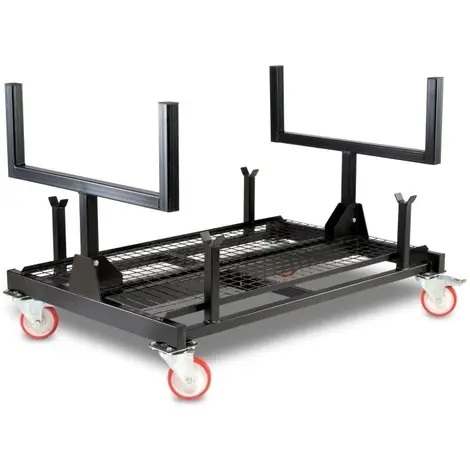 | Industrial Trolleys Capacity: 300-2000 Kg View product → |
When a Stock Trolley Is Not Enough
Choose a custom trolley when the load exceeds stock deck dimensions or wheel ratings, sits on uneven feet, has a high centre of gravity, or must pass through a fixed turning path. Customisation is also necessary for towing, powered movement, rail guidance, AGV pickup, special brakes, or controlled deck height.
A stock platform trolley can arrive faster, but its stated capacity may assume a uniformly distributed load on a level floor. Do not approve a quotation until the supplier checks your actual load and route.
| Stock platform trolley | Fixed deck, wheel layout, and payload rating | Regular loads, level floors, no special interfaces |
|---|---|---|
| Custom fabrication trolley | Sized for load centre, point loads, clearance, steering, and towing | Machines, moulds, coils, or restricted routes |
| AGV-compatible trolley | Adds docking features, sensor targets, emergency-stop interfaces, and alignment limits | Automated pickup and drop-off |
Ask a skid trolley supplier in Pune for these capacity checks:
- Conduct a site trial with the loaded trolley: record floor slope, surface joints, turning radius, starting force, stopping distance, and towing speed.
- Provide calculations for UDL, maximum point load, wheel reaction, deck deflection, load-centre position, gradient, and movement impact.
- State rated payload, UDL, point load, floor condition, and operating speed on the quotation and nameplate.
- Price drawing approval, fabrication, trial loading, delivery, and installation separately.
Frequently asked questions
What does a skid trolley capacity rating mean?
The rating is the maximum supported load under stated conditions. Check whether it applies to an evenly distributed load, specified floor, speed, slope, and operating method.
How much does a skid trolley cost in Pune?
A manual platform trolley costs about ₹20,000–₹60,000, a towable fabrication trolley ₹60,000–₹2.5 lakh, and a powered battery trolley ₹2–₹8 lakh. Custom heavy-duty designs can exceed ₹10 lakh.
How do I calculate the required skid trolley capacity?
Add the load, pallets or fixtures, and removable equipment, then account for the load centre, braking forces, slopes, turning, and uneven floor conditions. Specify a safety margin with the supplier.
Which skid trolley type suits my route?
Use a manual trolley for short, light movements; a towable trolley for repeated routes behind a tugger; a motorized trolley for independent movement; and a rail-guided trolley for fixed, repeatable paths.
What should I compare in Pune skid trolley quotations?
Compare rated capacity, deck size, frame steel, wheel type, brakes, steering, towing eye, surface treatment, battery and charger, testing documents, warranty, installation, and delivery.